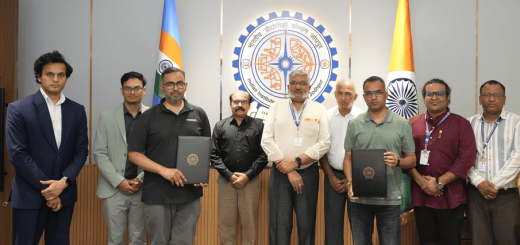

NIT Rourkela Launches Four New Programmes for Future-Ready Careers
New B.Tech and M.Tech courses in mathematics, physics, semiconductors and machine learning aim to build skills for India’s deep-tech economy

INN/Chennai, @Infodeaofficial
National Institute of Technology Rourkela (NIT Rourkela) is set to expand its academic portfolio with four new programmes from the 2026-27 academic session. The new courses are designed to strengthen interdisciplinary learning, advanced research and technology-driven innovation while preparing students for emerging industry needs in India’s fast-growing deep-tech landscape.
The institute will introduce two B.Tech. programmes — Mathematics & Computing and Engineering Physics — along with two M.Tech. programmes — Semiconductor Devices and Technology and Machine Learning and Signal Analysis. Together, these courses reflect NIT Rourkela’s effort to align higher education with the demands of digital transformation, semiconductor development, artificial intelligence, advanced manufacturing and scientific innovation.
New academic direction
According to Prof. Ashok Kumar Turuk, Dean Academic, NIT Rourkela, the new programmes are aligned with the vision of NEP 2020, which emphasizes multidisciplinary learning, flexibility, skill integration and research-driven innovation. He said subjects such as mathematics and physics should not be seen only as theoretical disciplines, but as the foundation of technologies shaping industry and society.
That approach is important at a time when India is pushing for a stronger knowledge economy. Universities and technical institutes are increasingly expected to produce graduates who can contribute not only to research but also to industrial problem-solving, product development and innovation.
Mathematics meets computing
The B.Tech. in Mathematics & Computing, offered by the Department of Mathematics, is designed to combine mathematics, computing and data science. The curriculum will include subjects such as data structures and algorithms, theory of computation, machine learning, artificial intelligence, cryptography, numerical analysis, statistical modelling and advanced computing.
The first batch will admit 25 students through JEE Main. Graduates of this programme are expected to find opportunities in software development, AI and machine learning, data science, quantitative finance, cybersecurity, research and academia.
Prof. Manas Ranjan Tripathy, HoD, said mathematics today is the backbone of artificial intelligence, cryptography, fintech, cybersecurity and advanced computing. The course, he noted, will prepare students for careers across both industry and research.
Engineering physics for deep-tech
The B.Tech. in Engineering Physics, offered by the Department of Physics and Astronomy, will focus on quantum technologies, semiconductor devices, photonics, nanotechnology, materials science, cryogenics, optoelectronics, spintronics, astronomy, space technology, high-energy physics and biophysics.
With an intake of 25 students, the programme will be admitted through JEE Main. It combines strong theoretical foundations with engineering training and laboratory exposure, making it suitable for students interested in advanced scientific innovation and frontier technologies.
Semiconductor skills for India
The M.Tech. in Semiconductor Devices and Technology is one of the most significant new additions, especially as India builds a stronger semiconductor ecosystem. With the country projected to need over one million skilled professionals in semiconductor and allied sectors over the next decade, the programme is aimed at creating a specialized workforce.
The course will cover semiconductor devices, IC fabrication, wafer technology, device characterisation, packaging technologies, modelling, simulation and advanced materials for electronic applications. The inaugural batch will have 15 students admitted through GATE.
Prof. Jyoti Prakash Kar, HoD, said the programme is aligned with major national missions including the India Semiconductor Mission, National Quantum Mission and National Space Mission. He added that the department aims to build a strong academic and research ecosystem in transformative technologies.
AI and signal analysis
The fourth programme, M.Tech. in Machine Learning and Signal Analysis, offered by the Department of Electronics and Communication Engineering, will focus on the intersection of artificial intelligence, data science and signal processing.
The course will cover deep learning, speech and image processing, autonomous systems, wireless communications and biomedical signal analysis. It aims to strengthen interdisciplinary research and foster collaboration across engineering, computer science and applied mathematics. The first batch will admit 12 students through GATE.
Why it matters
These four programmes place NIT Rourkela firmly in the next phase of technical education in India. By combining core science with advanced engineering and industry-linked learning, the institute is preparing students for careers in AI, semiconductors, quantum technologies, advanced manufacturing and research.
At a time when India needs skilled talent for its digital and industrial future, NIT Rourkela’s new courses are a timely step toward building a future-ready workforce.